
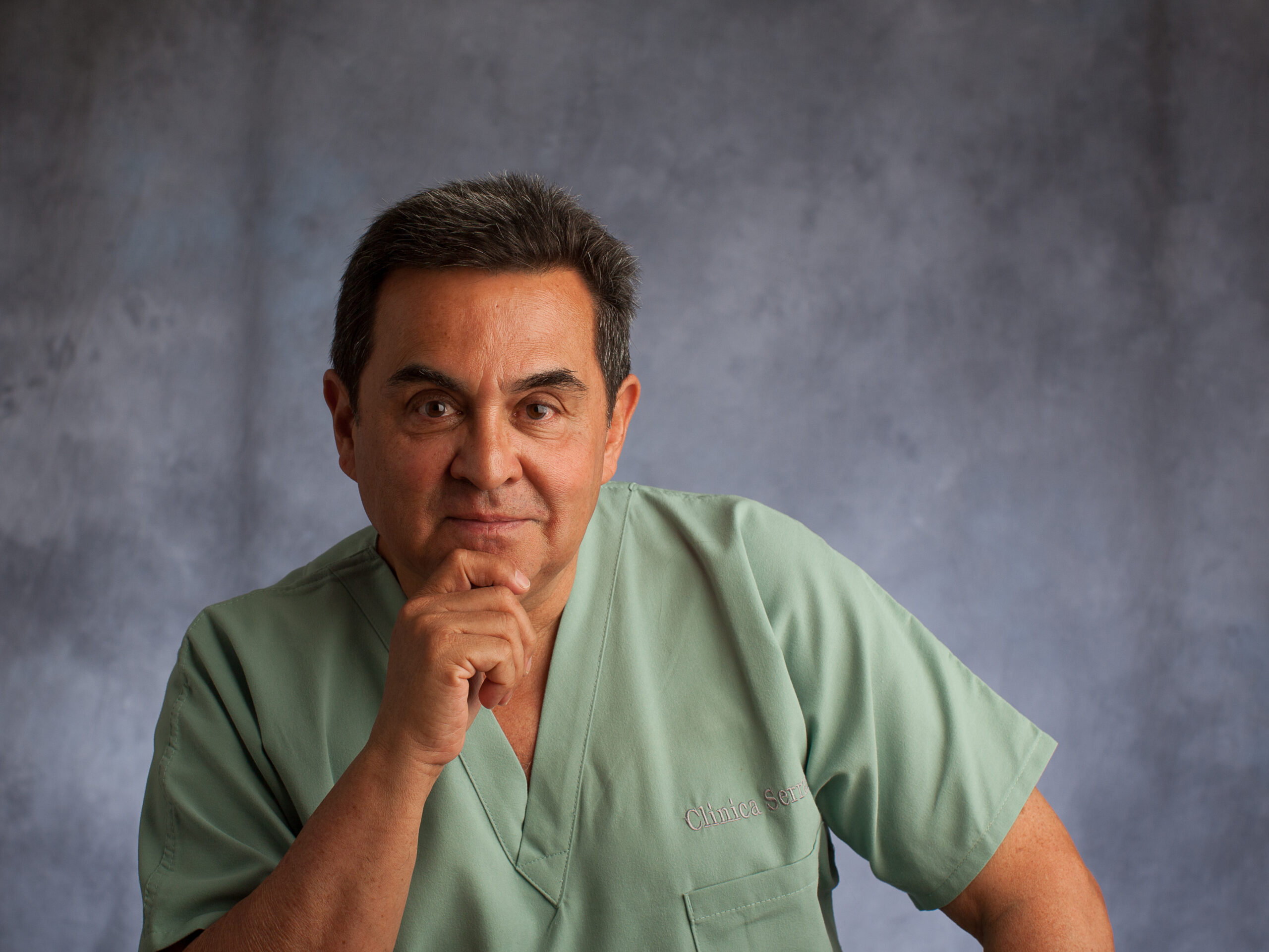
DR. GABRIEL SERRANO SANMIGUEL
A Physician Who Has Connected Dermatology, Photomedicine,
Pigmentary Disorders, Vitiligo and Formulation Science
And a Possible New Photobiological Chapter with NOVION™
A Firsthand Perspective by Mark Kim
1 | Why Dr. Gabriel Serrano Belongs in This History
Any history of medical lasers and aesthetic medicine told through the people who shaped the field would be incomplete without a separate chapter on Dr. Gabriel Serrano Sanmiguel of Valencia, Spain. He is not simply a dermatologist who uses lasers, nor merely an entrepreneur who founded a skincare company. Over more than four decades, he has connected clinical dermatology, photobiology and photosensitivity, pigmentary disorders, vitiligo, skin cancer, dermatologic formulation, nanotechnology and product development within one continuous clinical philosophy.
His professional biography describes decades of dermatology practice, tens of thousands of patients treated, pioneering work in approaches to vitiligo and skin cancer, and the founding of Sesderma and Mediderma in 1989. What distinguishes him is the persistence of the physician’s perspective: identifying an unmet clinical problem, investigating it, developing a formulation or therapeutic approach, and bringing the solution back to patients.
2 | His Scientific Roots Were in Light — Photosensitivity and Photobiology
It would be a mistake to understand Dr. Serrano only through modern dermocosmetics. His publication record reaches back to the early 1980s and includes photosensitivity, phototoxicity, photoallergy, chronic actinic dermatitis, drug-induced photosensitivity and broader aspects of photobiology.
In other words, an important scientific question has been present throughout his career: how does skin respond to light, how can a molecule alter that response, and how can light–molecule interactions translate into inflammation, pigmentation and cellular behavior? Those questions are directly relevant today when we discuss photodynamic therapy, photosensitizers, photobiomodulation and controlled light–drug interaction.
3 | Pigment Biology — Far More Than ‘Removing Pigment’
Another major axis of Dr. Serrano’s work is pigmentary disease. Pigment medicine cannot be reduced to destroying melanin or simply making skin lighter. It involves melanocyte biology, inflammation, oxidative stress, ultraviolet response, barrier condition, hormonal influences, immune signaling and recurrence.
His earlier publications include work on Riehl’s melanosis and pigmented contact dermatitis, and his later clinical and product-development activities have addressed both hyperpigmentation and hypopigmentation. For this reason, I regard him not merely as a ‘laser doctor,’ but as a dermatologist who has spent decades studying and treating the biology and clinical behavior of skin pigmentation.
4 | Vitiligo — Understanding Both Excess Pigment and Loss of Pigment
Vitiligo is particularly important in understanding Dr. Serrano’s clinical identity. His professional materials describe him as a pioneer in developing approaches and solutions for vitiligo, and his work has included phototherapy, excimer laser, ultraviolet-based approaches, micro-photoirradiation/repigmentation strategies, topical products and other multimodal concepts.
In 2009, Serrano and colleagues reported clinical experience using repeated low-strength 5-aminolevulinic acid (ALA) photodynamic therapy with short contact periods in patients with acne, photoaging and vitiligo. This was exploratory work rather than proof that PDT is an established treatment for vitiligo. That distinction matters. A pioneer asks an unconventional question; science then determines whether the answer survives controlled validation.
5 | Beyond the Laser: The Relationship Between Light, Molecule and Cell
This is also why I see a potentially meaningful connection between Dr. Serrano and the future of NOVION. Traditional medical-laser history developed around wavelength, chromophore, fluence, pulse duration and controlled thermal injury. Serrano’s scientific trajectory adds another axis: photosensitive molecules, drug–light interactions, pigment cells, inflammatory biology and the biochemical environment of the skin.
LIGHT × MOLECULE × CELL × MICROENVIRONMENT
In this framework, light is not only an energy source that heats, coagulates, ablates or selectively destroys tissue. Under the correct conditions, it may function as a trigger whose biological effect depends on the molecule, cell state and local microenvironment. That is the scientific territory that must be defined if a photosensitizer is to be combined with a controlled optical platform.
6 | Clinician → Laboratory → Product → Patient → Global Market
Another reason Dr. Serrano is unusual is that he did not separate clinical practice from manufacturing and formulation. When he identified a problem for which existing solutions were inadequate, he investigated it, formulated a product, brought it into clinical use and then expanded successful solutions internationally through Sesderma and Mediderma.
CLINICAL PROBLEM → FORMULATION → DELIVERY → CLINICAL USE → ITERATION
His more recent interests have extended into nanotechnology, advanced active ingredients and formulation science. His greatest asset, therefore, may not be any single product. It is a repeatable method: identify a real skin problem, understand the biology, design a practical intervention, observe the clinical response and continue to refine it.
7 | 2026, New Delhi — Photosensitizer × NOVION™
In August 2026, Dr. Serrano called me from New Delhi and discussed a photosensitizer he is developing and the possibility of exploring it together with NOVION. After four decades of witnessing successive generations of medical-laser technology, I did not hear this simply as another proposal to combine a cosmetic product with a device.
The deeper scientific question is whether a defined photosensitizing system can be spectrally and biologically matched with NOVION’s controlled optical emission to generate a reproducible photochemical or photobiological response that is meaningfully different from conventional photothermal treatment.
PHOTOSENSITIZER → SPECTRAL MATCHING → OPTICAL DOSE → CELLULAR RESPONSE → CLINICAL ENDPOINT
8 | A ‘New Era’ Must Be Created by Data, Not by Claims
If we want this project to become important, scientific discipline must come before marketing language. Neither Dr. Serrano’s reputation nor the NOVION vision is sufficient to create a new therapeutic category.
We would need to define the photosensitizer’s chemical identity and absorption spectrum, photostability, tissue penetration, mechanism of photochemical action, dark toxicity and phototoxicity, wavelength–dose relationship, histologic and molecular response, and ultimately controlled clinical evidence.
This is especially important in complex pigmentary disorders such as melasma and vitiligo. These are multifactorial diseases and should not be reduced to a single optical mechanism. The first question for a NOVION–photosensitizer program should therefore not be, ‘What disease can we claim to treat?’ It should be, ‘Which biological pathway can we reproducibly influence, at what wavelength, dose and molecular concentration, within a defensible safety window?’
9 | Dr. Serrano × NOVION — A Research Framework Worth Testing
| Research Axis | Core Question | Initial Output |
| Photochemistry | At which wavelengths does the photosensitizer absorb, and how strongly? | Absorption spectrum / photostability |
| Optical Matching | How closely does that spectrum overlap with actual NOVION emission? | Spectral overlap map |
| Dose Biology | What cellular responses occur across concentration, irradiance and exposure time? | Dose–response matrix |
| Safety | What are the dark-toxicity and phototoxicity windows? | Cell viability / safety window |
| Pigment Biology | How are melanocytes, keratinocytes, oxidative stress and inflammatory signaling affected? | Pigment / oxidative / inflammatory biomarkers |
| Tissue Response | What occurs across epidermis, basal layer and dermis? | Histology / imaging |
| Clinical Translation | Which indication provides the most rational first clinical model? | Pilot protocol with objective endpoints |
10 | Mark Kim’s Record — Remembering the Pioneers While Writing the Next Chapter
I have had the privilege of meeting and working around people from many generations of laser medicine — Goldman, Apfelberg, Ohshiro, Kaufmann, Anderson, Karni and many others. I record that history not simply to celebrate the past, but to understand how important categories were actually created: someone asked a new question, someone built the physics, someone tested it clinically, and eventually the evidence became strong enough to change practice.
Dr. Gabriel Serrano occupies a distinctive position in that history. He has never looked only at light. He has never looked only at drugs or cosmetics. He has never looked only at pigment. He has spent decades looking at the skin as one biological system in which light, molecules, melanocytes, inflammation, clinical medicine and formulation interact.
Now there is an opportunity for that experience to meet NOVION. I find that genuinely exciting. But if we truly want to open a new era, it must begin with an experiment, not a declaration. Every important chapter in medical technology began with a precise question that could be tested.
THE HISTORY IS NOT FINISHED.
THE NEXT CHAPTER MUST BE WRITTEN WITH SCIENCE.
Selected Objective Background
- Serrano’s publication archive documents work from the early 1980s onward in photosensitivity, phototoxicity, photoallergy, photobiology and pigment-related dermatology.
- His professional biography records medical training at the University of Valencia, a cum laude medical doctorate focused on drug-induced photosensitivity, more than 25 years in a senior clinical dermatology role at Hospital General Universitario de Valencia, and the founding of Sesderma in 1989.
- His professional materials describe continued clinical practice, international teaching and extensive publication activity, as well as longstanding work involving vitiligo and skin cancer.
- Serrano et al. published a 2009 clinical report of repeated low-strength ALA-PDT with short contact periods in acne, photoaging and vitiligo.
- The proposed photosensitizer × NOVION program described in this document is a future R&D direction. Its mechanism, safety, efficacy and clinical indications remain to be established experimentally.
Written by Mark Kim
Seoul, Korea · August 2026