
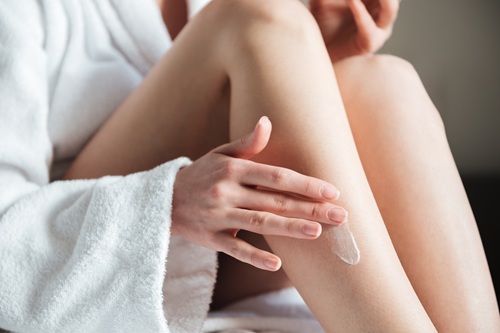
When your skin is dry, it’s not enough to just apply any cream from time to time. You need to use specific formulas that moisturize, repair, and nourish your skin, and apply them correctly. In this guide, you’ll find key criteria for choosing the best body moisturizer for you, ingredients with proven benefits, and a simple routine to boost results and improve your skin’s condition.
What is really happening when you have dry skin on your body?
Dry skin does not mean “lack of water,” but rather an alteration of the skin barrier, where the lipids that act as ‘cement’ between the cells, known as “bricks,” are diminished. This facilitates moisture loss and abnormal cell flaking. The typical result is rougher, duller, rough skin with a frequent feeling of tightness and itching.
Therefore, a body moisturizer that is effective for dry skin must combine three actions: attract water (humectants), repair (emollients), and prevent evaporation (occlusives). In this way, we will achieve both active and passive hydration, in addition to strengthening the skin’s barrier function.
Ingredients that work on dry skin: how to read a label without going crazy
In cosmetics, it almost all comes down to understanding the role each family of ingredients plays. When choosing a body moisturizer for dry skin, look for balance: if it only contains humectants, it may fall short; if it only contains occlusives, it may feel heavy; and if it only contains emollients, the softness may be short-lived.
| Type of ingredient | What it does | Common examples | Recommended for… |
|---|---|---|---|
| Moisturizers | Attract and retain water in the skin | Glycerin, hyaluronic acid, urea, panthenol | Oily and dehydrated skin |
| Emollients / Barrier repairers | Fill in the “spaces” between skin cells | Shea butter, vegetable oils, ceramides | Impaired barrier function |
| Occlusives | Form a film that prevents water evaporation | Petrolatum, lanolin | Dry and dehydrated skin |
A useful tip: if your skin is very dry, a richer texture (cream or balm) usually works best. However, the choice of texture should be tailored to individual preferences and skin tolerance, as the best moisturizer is, in practice, the one you use regularly.
How to choose the best body moisturizer for you
Instead of chasing “the number one,” refine your search based on your needs. That way, you’ll get it right sooner and reduce blind purchases. These scenarios are the most common when looking for body moisturizers for dry skin:
If you experience dryness with tightness and flaking
When the skin continuously loses water, skin renewal slows down and dead cells accumulate on the surface, resulting in rough texture, tightness, and even itching. The priority is to replenish water and prevent its loss, so you need a formula with a combination of moisturizers and occlusives. These are usually found in richer textures such as thick creams or balms, to be applied mainly to the legs and arms.
- Look for: glycerin, urea, hyaluronic acid, ceramides.
- Avoid (if it irritates you): strong perfumes or drying alcohols.
If your skin feels dry, itchy, or prone to irritation
The problem here is not just a lack of moisture, but a compromised skin barrier, which causes the skin to react easily. The key is to prioritize comfort and restore the barrier function. Choose simple, well-tolerated formulas for regular use, and test them on a small area first.
- Look for: soothing active ingredients, ceramides, cholesterol.
- Avoid: irritating extracts and changing creams frequently without giving them time to work.
If there are lesions, persistent redness, or suspected dermatitis, it is advisable to consult a medical professional.
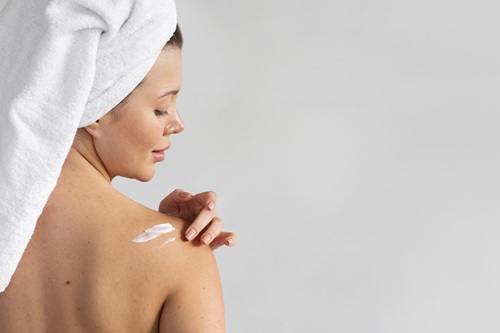
If you have very rough skin or “alligator skin”
When the skin has a very rough surface, there is usually an alteration in the natural exfoliation process, which makes it difficult for moisturizing products to be distributed and act effectively. In these cases, the most effective strategy is to combine moisturizing with gentle exfoliation.
The goal is not to “scrub” aggressively, but to promote controlled skin renewal, always in a gradual and respectful manner, resulting in a more uniform surface so that the body moisturizer can have a deep and lasting effect.
- Look for: ceramides, urea, hyaluronic acid.
- Avoid: aggressive or very frequent mechanical exfoliation.
If you want powerful hydration without feeling greasy: textures, sensations, and daily use
Regardless of the type of dryness, sticking to your treatment is key. An effective cream is one that is used regularly, so the texture, finish, and sensation after application directly influence the results.
- Ideal for daily use: fast-absorbing lotions.
- Reserve richer formulas for specific areas (elbows, knees, pimples) or specific moments.
Think of your routine as a wardrobe: not everything is for every moment, but you can have “a basic” and “a reinforcement.”
When is the best time to apply body cream?
Application is often overlooked. If you want your moisturizing body cream for dry skin to work effectively, the best time to apply it is right after showering, when your skin is still slightly damp: this way, there is more water “available” to retain.
- Pat your skin dry without rubbing (especially if you have sensitive skin).
- Apply the cream within the first 3–5 minutes after showering.
- Focus on critical areas: shins, elbows, knees, and hands.
- If your skin is very dry, apply the cream at least twice a day.
This simple habit is often more decisive than changing products every two weeks. Consistency turns a good formula into the best moisturizer for you.
Common mistakes that worsen dryness (and how to avoid them)
In many cases, the problem isn’t the cream, but how and when it’s used. Changing two or three habits can improve results without spending more.
- Very hot water: it can remove moisture from the skin, increasing the feeling of tightness when you get out.
- Harsh soaps: they clean, yes, but sometimes they strip too much.
- Rubbing with a towel: worsens comfort on reactive skin.
- Over-exfoliating: skin becomes more exposed and sensitive.
If your skin is particularly dry in winter or with air conditioning, think about “barrier protection”: it’s not just about moisturizing, it’s about preventing it from losing what it already has.
Now that you know everything there is to know about body creams… Sesderma products that are suitable for dry skin
UREMOL CICA: dryness with tightness and flaking
If your skin is very dry, rough, or visibly flaky—described as “crocodile skin”—UREMOL CICA goes one step further in hydration. Urea, a natural component of the skin’s moisturizing factor, helps not only to attract water but also to improve the texture and softness of the roughest areas.
This body cream is especially suitable for legs, arms, elbows, or knees when dryness is persistent and other creams fall short. In addition to deeply moisturizing and strengthening the skin barrier, it helps reverse the signs of dehydration and relieve the tightness and itching associated with very dry skin.
SESPANTHENOL COMFORT: dry skin with itching or a tendency to irritation
When dry skin also becomes sensitive, reactive, or itchy, the priority changes: it is no longer just about moisturizing, but also soothing and repairing. In these cases, SESPANTHENOL COMFORT is designed to restore a feeling of comfort to fragile skin.
Panthenol, together with soothing and repairing active ingredients, helps to strengthen the barrier function and repair and regenerate the skin. It also reduces feelings of burning, tightness, or redness.
CERASES PROTECT: very rough texture or ‘crocodile skin’
If you have dry or very dry skin and find that, even though you moisturize, your skin doesn’t feel comfortable all day long, CERASES PROTECT is a good option for immediately, deeply, and lastingly strengthening the skin barrier. Its formula combines ceramides—the skin’s “structural” lipids—with moisturizing agents that help retain water and improve elasticity.
It is the ideal type of body cream for daily moisturizing: it provides intense nourishment, leaves the skin soft and supple, and helps protect it from external aggressions without feeling heavy.
When dryness is also noticeable on the face (tightness, lack of elasticity, dull appearance), more comprehensive moisturizing is recommended. If you want to explore options, here is a selection of facial moisturizing solutions.
Finding the best body moisturizer for dry skin means choosing formulas with the right ingredients, a texture that suits you, and consistent application. When formula, texture, and habit align, moisturizing becomes a real skincare routine that keeps your skin healthy day after day.


